
Looking through my deck collection, I started paying special attention to the creators of and the representation in each deck. There’s a difference between art that resonates aesthetically and work that connects with one’s identity. I have always been Obviously Black, but I am also isolated in my Blackness as a disabled queer who grew up in environments where I’m the tokenized spoke-person for what Blackness means.
I often resent(ed) this role, especially because my Blackness was called into question on all sides without consideration for my lived experience. I look(ed) for ways to push back against external assumptions of what a Black narrative should be, and this spilled over to my own personal expectations and practices.
Why was I trying to fit my understanding and experience of tarot into a model that (at best) completely disregarded my ancestry and (at worst) demonized it?
I was tired of ubiquitous associations of darkness with evil and light with purity and cleanliness. How could I reframe my vocabulary and my own mental associations? I started looking for tools and resources to enrich my own understanding of Black spirituality beyond the narratives I’d been taught.
Sometimes I wonder if I’m asking for too much, wanting a deck that represents Black AND Queer AND Disabled bodies all at once, in all their difference and divinity. But then I remember that this wanting is not just for me; it is for everyone else whose stories are parallel, perpendicular, paradoxical to mine.
(And even if it was just for me…I might just be worth it.)
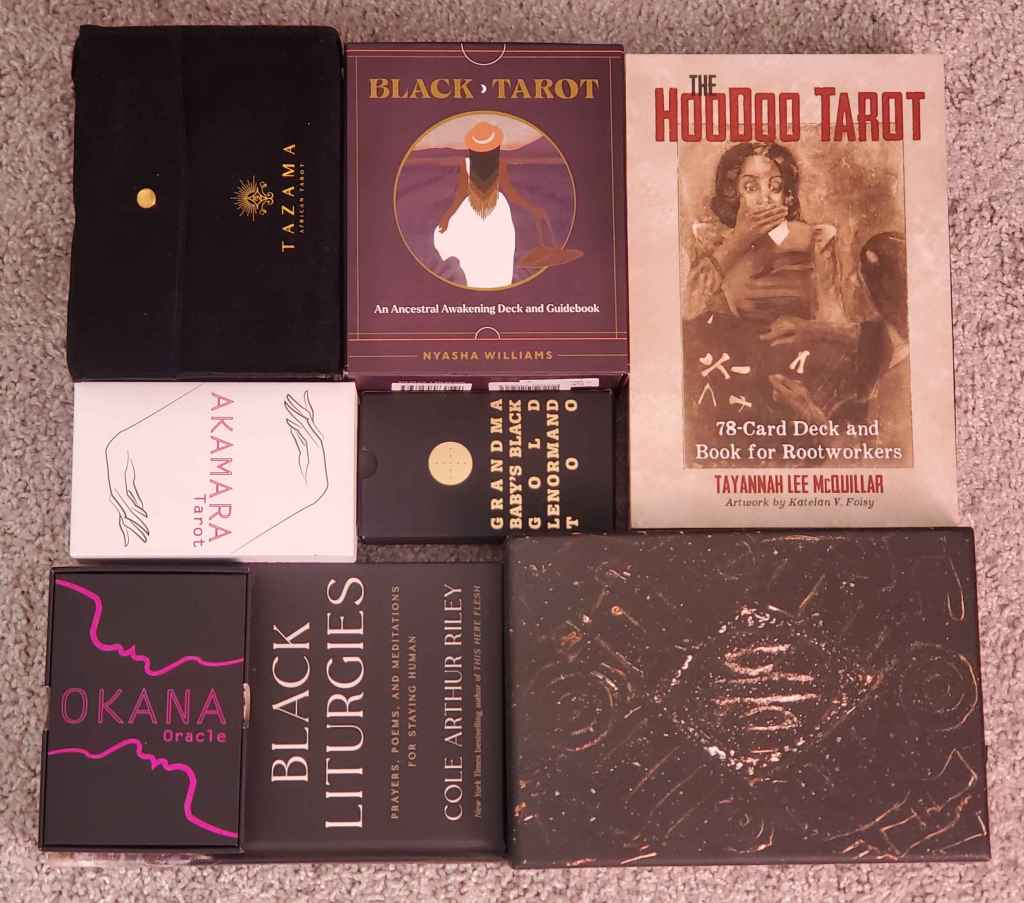
For a while, I felt proud of myself for this growth. I was interrogating my assumptions, examining the elements of my practice, and finding resources that helped me think differently about the world around me. I met other people who were doing the same, and my conversations with them were encouraging and challenging. But then I started to doubt myself.
Thinking of the decks I’d purchased before I’d begun scrutinizing my journey, I started to wonder. Did having or using those decks count against me, somehow? Was I afraid others would call my Blackness into question? Was I betraying yet another unspoken rule I hadn’t yet learned about how I was “supposed” to be Black?
I often find myself desiring community with other Black folks, but I admit I am constantly worried about rejection in those spaces. I’ve been working on giving myself a chance to be known in those spaces, and that has intersected with me questioning how I go about my practice. I’ve always been aware, and often painfully so, that my Black experience was different. From that of my peers, from what others expected of me, I have never quite fit.
In the same way I have learned to own my experiences in academia, in professional settings, as an artist and writer–I’m learning to accept and embrace it in this context too. Again, and all over again, one might say. I worried I’d be criticized or judged because of my connections with decks I’ve purchased from non-Black creators. My relationship to those decks, and indeed with non-Black friends, is reflective of my lived experience.
If I am judged for not being enough of an exclusionist, then so be it. I’m keenly aware of the spaces where I carry my Blackness. I know all the ways it doesn’t fit, and yet over and over again I find myself in a position to offer a unique perspective that no one else in the room could have given. I help people think about things in new ways, no matter where I am, and part of that is because of the mosaic of experiences that inform and resonate with my understanding of the world.
Having boundaries in place when pulling cards is a standard practice, whether one is pulling for themselves or someone else. There are some decks I only use with or offer to Black folks. Is this kind of exclusionary? Yes. Another way to think of it is this: these decks represent a closed part of my practice.
The point of closed practices is that they’re limited to a specific group. While I carry my Blackness with me wherever I go, there are some things about being Black that I only talk about with other Black people. We have our own celebrations, grievances, wisdom, and traditions. There are specific parts of all those things that I only share in trusted confidence with other Black folks.
At the same time, those things get integrated into how I see the world and my interactions with others. That includes the decks I buy, and how I pull cards, and where I find community. It might not look like someone else’s practice, or how people expect a Black Reader to work, but maybe that’s the point.
 V. H. King's Ink